
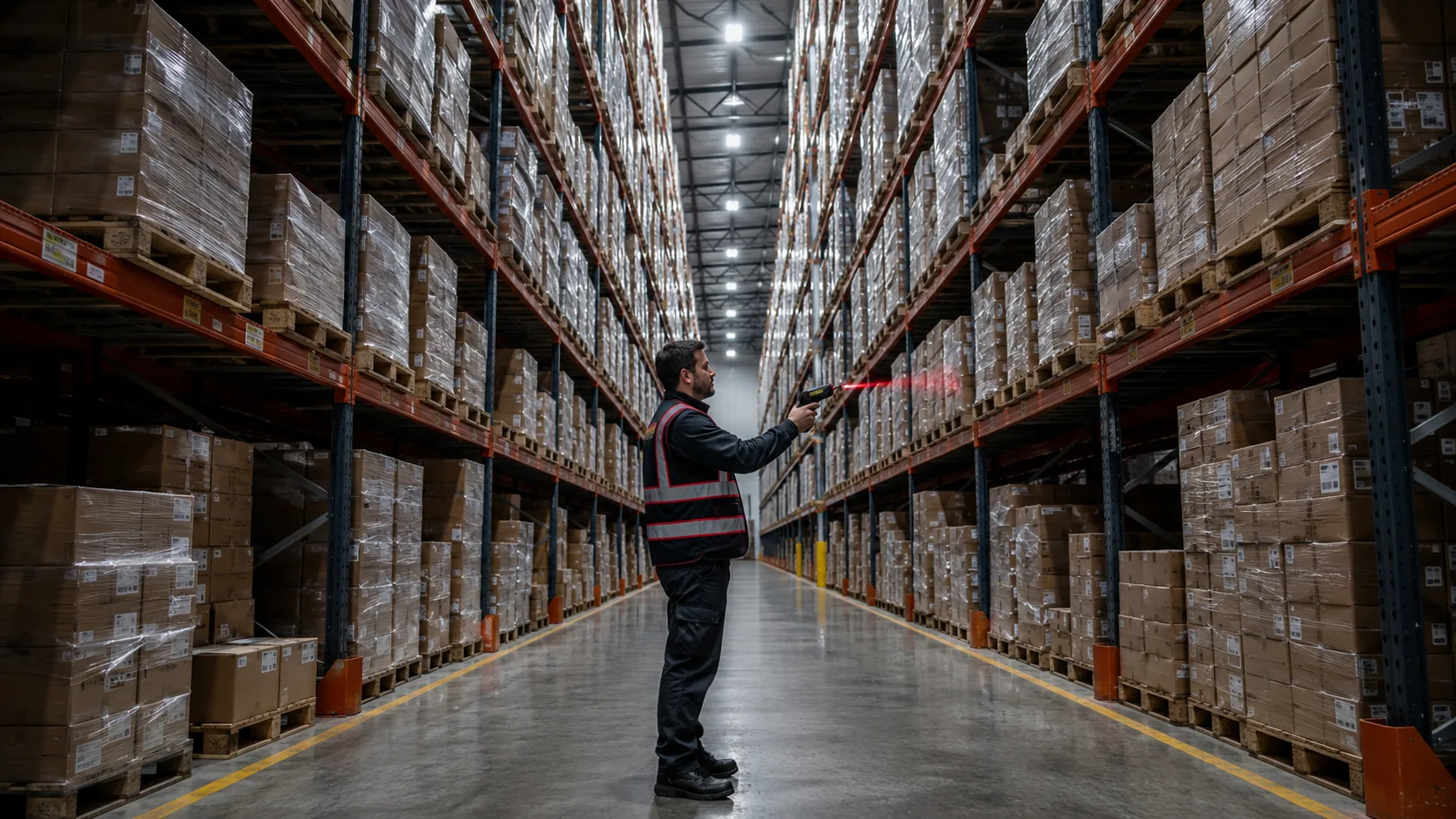
Every warehouse IT team has fought this war. You add access points. Coverage improves for a week. Then a new SKU mix changes how the racks are packed, and the dead zones move. You add more APs. Now they interfere with each other. The scanners still drop at the back of aisle 14.
It's not your gear or your team. Wi-Fi is being asked to do something it was never designed for.
Why the building beats Wi-Fi
Wi-Fi runs at 2.4 and 5 GHz with low power and short range — fine for an office, brutal in a warehouse. Three things in particular wreck it:
- Height and racking. Signal has to travel up, over, and around steel shelving packed with dense, often metal or liquid, inventory. Every rack is a wall.
- Cold rooms. Insulated panels and refrigerated air are murder on high-frequency signal, and you can't exactly fill a freezer with access points.
- Roaming. A forklift moving at speed hands off between APs constantly; each handoff is a chance to drop the scan, the call, or the telemetry.
So you end up with a patchwork: lots of radios, lots of overlap, lots of seams — and the seams are exactly where work breaks.
What CBRS changes
Private LTE/5G on CBRS (the 3.5 GHz band the FCC opened for shared private use) is a different tool for a different job. Cellular was engineered from day one for wide-area coverage, moving devices, and clean handoffs. In a warehouse that means:
- Coverage from far fewer radios. One sector can blanket a footprint that would take a dozen APs — through racking and into spaces Wi-Fi gives up on.
- Interference-protected spectrum. CBRS is coordinated, so you're not fighting every other 2.4 GHz device in the building. No ongoing spectrum cost, either.
- Seamless mobility. Devices stay connected as they move — down the aisle, into the freezer, out to the yard — without the handoff stutter.
- Control. It's your network. You issue the SIMs, set the priorities (safety traffic over video, say), and keep it segmented from corporate IT.
The part that matters most
Reliable coverage isn't just a connectivity win — it's the prerequisite for everything else. Collision-avoidance telemetry, real-time location, push-to-talk, cold-chain sensors: all of it depends on a network that doesn't have seams. Fix the foundation and the dead zones stop being the reason your good ideas stall in one aisle.
You don't have to rip out what works. Most modern scanners, tablets, and IoT gateways already speak CBRS — you add SIMs, not a new fleet. The difference shows up the first time someone scans at the back of aisle 14 and it just works.