
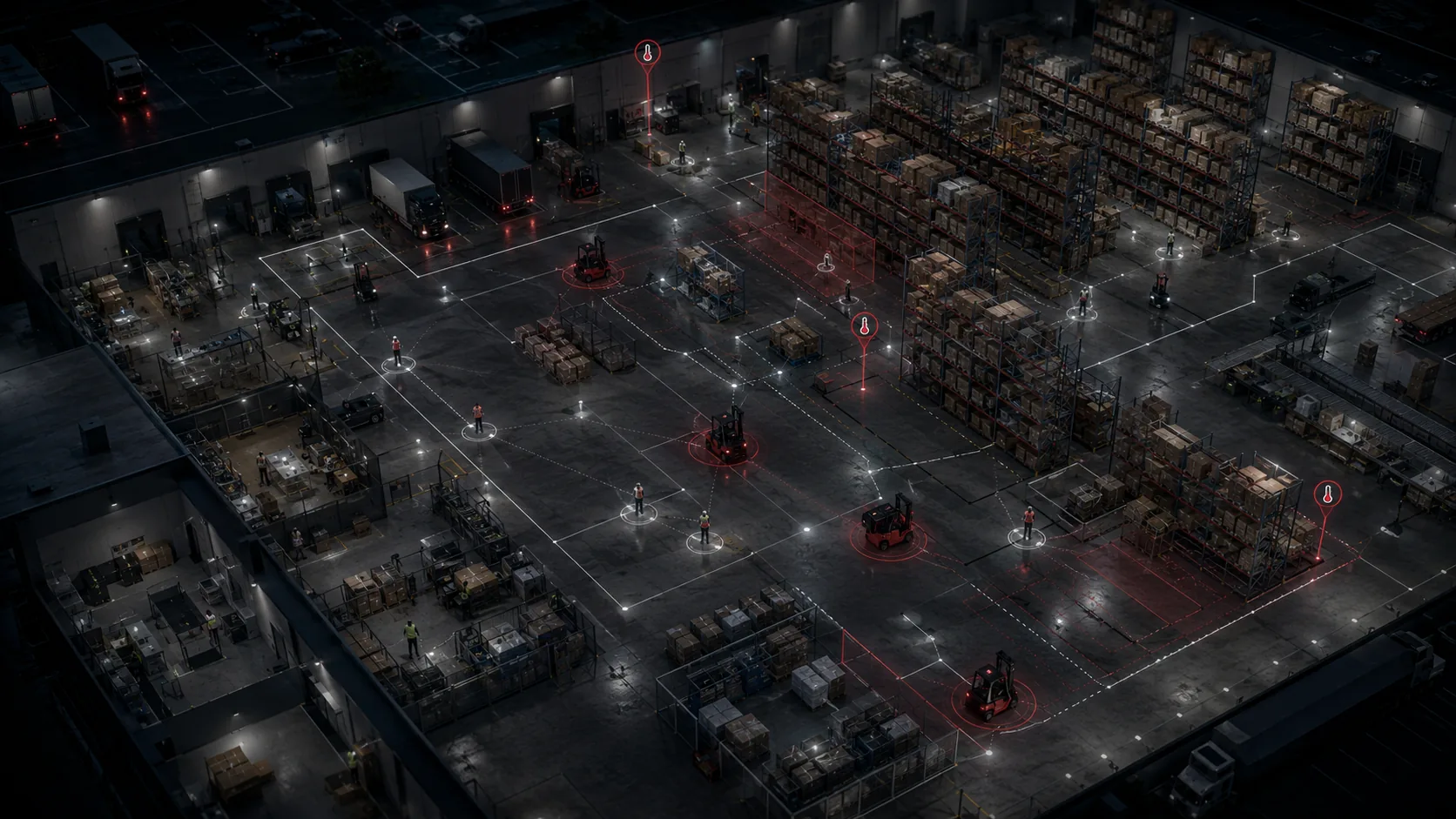
When most vendors say "digital twin," they mean a 3D rendering of your building — pretty, static, and disconnected from anything actually happening inside it. That's a model, not a twin. A twin is live. It reflects the real state of the operation right now, and you can ask it questions.
Live, not rendered
On a logistics floor, a real digital twin is one pane of glass that shows, in real time:
- Where every worker is — and where every forklift is, with speed and dwell time.
- Which zones are being accessed, and by whom.
- Temperatures across the building, room by room.
- Where people and vehicles concentrate — your real traffic, not the traffic on the floor plan.
- And, when the use case calls for it, the location of inventory down to a single item on a single pallet.
None of that comes from a rendering engine. It comes from sensors, tags, and positioning data flowing continuously off the floor.
Why it has to be fed by the floor
The twin is only as good as the data underneath it, and that data has to arrive from everywhere — through racking, in the freezer, out in the yard — without dropping. That's the part nobody puts in the brochure: a live twin depends on a network that blankets the whole operation with low, predictable latency. Lose coverage in an aisle and the twin goes blind in that aisle.
This is why we treat the twin as the output of an integrated solution rather than a product you buy on its own. Safety, location, comms, and environmental sensing each contribute a layer; the network carries them; the twin is where they correlate.
What you do with it
A live twin earns its keep the moment you can ask it something you couldn't answer before. Where do near-misses cluster? Which dock is the real bottleneck at 2pm? Did that reefer hold temperature through the whole shift? Which forklift has been idle for an hour? The answers stop being someone's best guess and start being a query.
That's the bar. If you can see your operation and interrogate it in real time — not admire a model of it — you have a digital twin. If you can't, you have a rendering.