
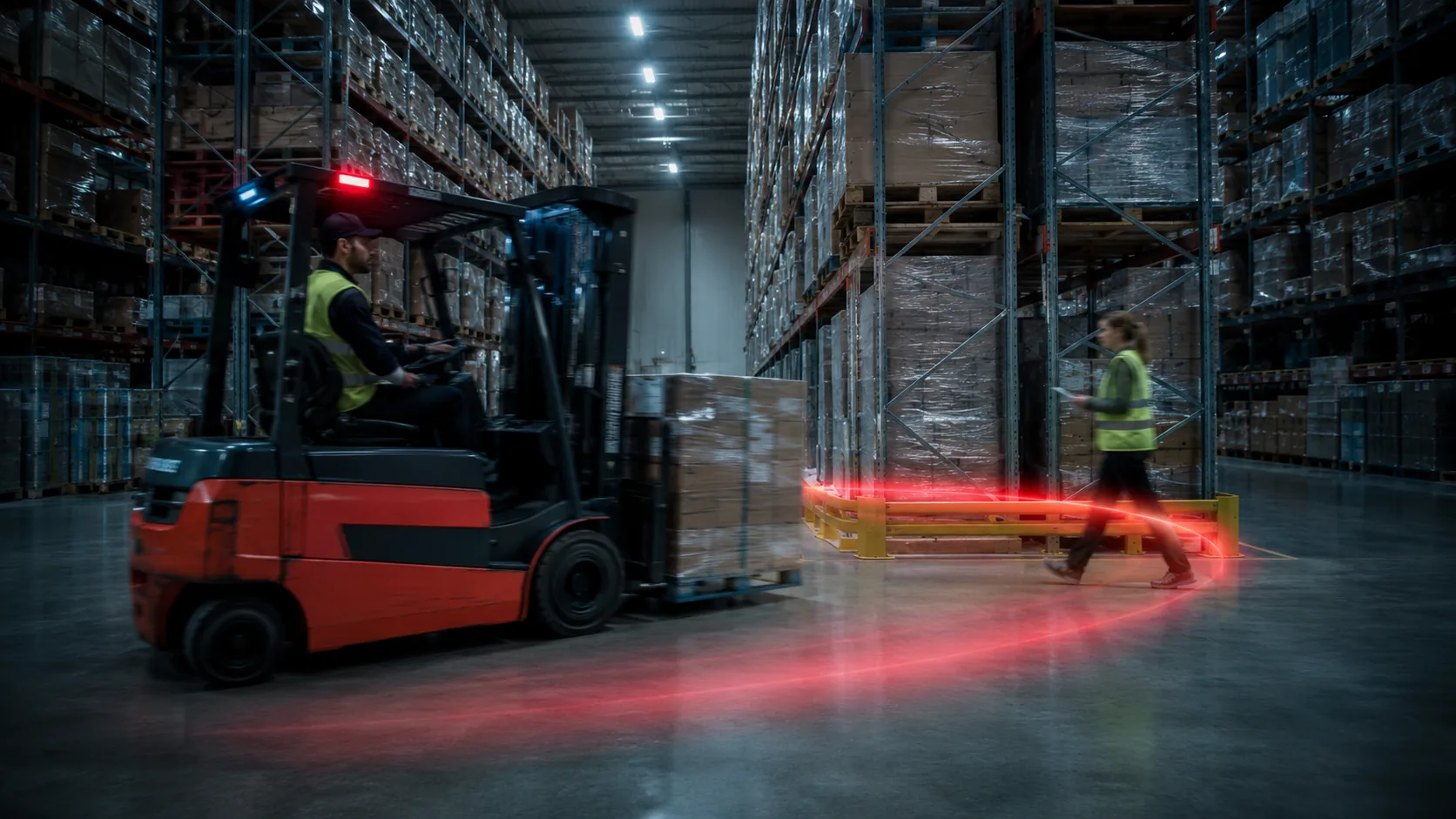
Talk to any safety lead and they'll tell you the same thing: the dangerous moment isn't the open aisle where everyone can see. It's the blind corner, the busy dock, the reverse maneuver — the last few feet where a forklift and a person end up in the same space before either reacts. The technology you choose either acts in that window or it doesn't.
Where cameras struggle
Camera systems are appealing because they're visual and easy to demo. But a warehouse is hostile to vision: dust, glare, low light, and racks that physically block the view around a corner. A camera can't see a worker who hasn't entered the frame yet, and the moment they do, you may already be inside the danger zone. Vision is also probabilistic — it's classifying pixels — which means false alarms that crews learn to ignore.
Where buzzers and RFID fall short
Simple proximity buzzers and RFID gates trigger on presence, not precise distance. They tend to fire constantly in tight spaces (so people tune them out) or only at fixed choke points (so they miss everything in between). Neither gives you the one thing that actually matters: how far away is this person, right now, in this direction?
Why ultra-wideband is different
Ultra-wideband (UWB) measures the actual distance between two radios with sub-foot accuracy, many times a second, and it doesn't care about light, dust, or line of sight the way a camera does. That's the core of how ECHO SLAM works: sensor pods around the vehicle and tags worn by workers continuously range against each other in every direction — front, rear, left, right.
Because it's measuring real distance, the system can run graduated zones: a soft warning at distance to change behavior, and a hard alarm up close when it counts — with hysteresis so the alerts don't chatter and get ignored. And it runs on the equipment itself, so the alert fires whether or not the network is up.
Then it gets smarter with zones — and data
Fixed beacons let you tighten thresholds automatically where you need it: blind corners, pedestrian walkways, dock edges. And because every proximity event is logged, "safety" stops being a binder of incident reports and becomes data — heatmaps of where near-misses cluster, trends that show whether a change worked, and records you can hand an auditor or an insurer.
Cameras and buzzers have their place. But if the goal is to act in the last few feet — reliably, in the dark, around a corner — distance is the measurement that matters, and UWB is what measures it.