
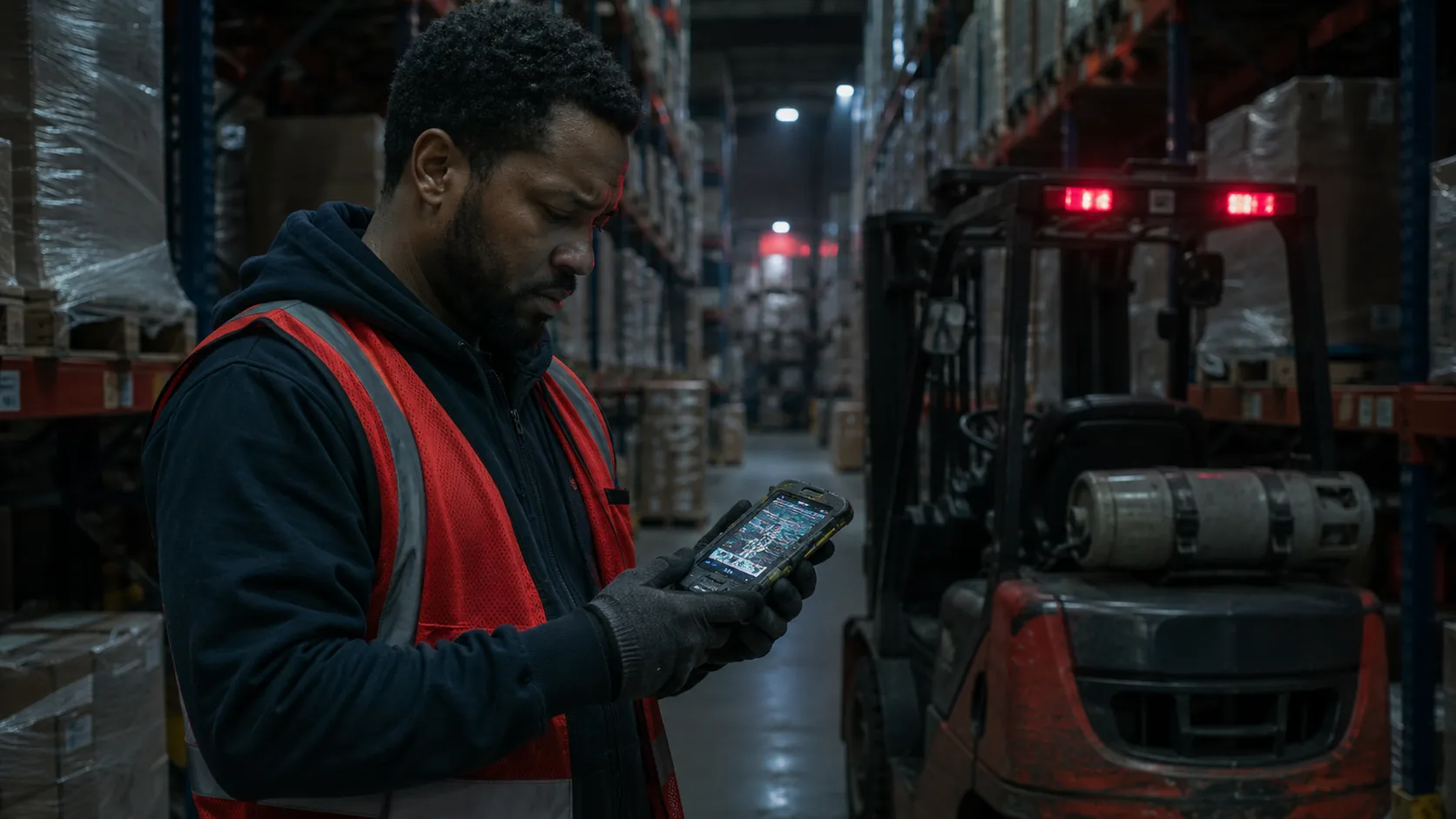
Walk a hundred distribution centers and you'll hear the same story. There was a transformation initiative. There was a pilot. There were dashboards. And eighteen months later, the forklifts still run on tribal knowledge, the scanners still drop at the back of the rack, and the "single source of truth" is a spreadsheet someone updates on Fridays.
The instinct is to blame the software. It's almost never the software.
The software-first trap
Most transformation programs start at the top of the stack: pick an app, buy a platform, stand up a dashboard. That's the part that demos well. But every one of those tools makes the same quiet assumption — that there's a reliable network and a connected fleet of devices underneath it. In a warehouse, that assumption is usually false.
Tall racking, steel, and refrigerated rooms turn Wi-Fi into a patchwork of dead zones. Public carriers stop at the gate. So the data that's supposed to feed your shiny new platform arrives late, partial, or not at all. The dashboard isn't wrong — it's just starved.
The floor doesn't run on dashboards
Here's the tell: a transformation is real when it changes what happens on the floor, not what's on a screen in the office. Fewer near-misses. Faster put-away. A reefer excursion caught before the load is lost. If your initiative can't point to a change in the operation — only in reporting — it hasn't transformed anything yet.
And operations are unforgiving. A safety system that works in three aisles but not the fourth isn't a safety system. A location feature that goes dark in the yard isn't real-time location. Coverage that's "mostly fine" is the reason the rollout quietly stops at one zone.
Start with the foundation you own
The projects that stick invert the order. They start one layer deeper — with a network the operator actually owns and controls, engineered for the building it lives in. Once coverage holds everywhere assets move, the rest stops being a gamble: safety, push-to-talk, location, and sensing all ride the same backbone and finally share one source of truth.
That's the unlock. Not another app on a foundation you rent, but a foundation you own that the apps can stand on. It's less glamorous than a slick dashboard, and it's the difference between a pilot that stalls and an operation that's genuinely different a year later.
If your last transformation effort fizzled, it's worth asking whether you started in the wrong place. Most do.